
The Complete Guide to Exposed Aggregate Driveways

Updated: Feb 2
Driveways are often the first thing people notice about an Australian home. They serve as the "welcome mat" for your property, bridging the gap between the public street and your private sanctuary. While traditional grey concrete has been the standard for decades across the suburbs, homeowners are increasingly turning to a more sophisticated, durable, and visually striking alternative: Exposed Aggregate Driveway solutions.
Whether you are a homeowner planning a renovation, a builder looking for technical specifications in Melbourne, or a property owner wanting to ensure they get the best value from a professional contractor in Brisbane, this guide provides the depth of information you need to move from the planning phase to a stunning finished product.
1. What is Exposed Aggregate Concrete?
At its core, an exposed concrete driveway is a form of decorative paving that utilises a technique dating back to the early 20th century, though it has seen a massive resurgence in modern luxury Australian landscaping. In standard concrete, the surface is "finished" by smoothing it over so that the cement paste (the "cream") covers the internal structural materials. In an aggregate concrete driveway, the opposite happens: the top layer of cement paste is carefully removed during the curing process to reveal the decorative stones, pebbles, shells, or sands hidden within the mix.
Think of it like a granite benchtop versus a painted wooden one. Standard concrete hides its ingredients behind a uniform mask of grey; Exposed aggregate concrete driveways celebrate the raw, geological beauty of the materials themselves. The result is a surface that looks more like a natural stone path or a riverbed than a man-made slab. It offers a "3D" depth that other concrete finishes simply cannot replicate.

The Anatomy of the Mix
A professional-grade aggregate mix consists of several primary components that must be scientifically balanced. If the ratio is off, the driveway may look beautiful on day one but could crumble or crack within a year under the harsh Australian sun.
Cement and Water: This forms the "matrix." A professional installer will use a specific water-to-cement ratio (usually around 0.45 to 0.50) to ensure the paste is strong enough to hold heavy stones while remaining workable enough to achieve a smooth level across the entire pebblecrete driveway surface.
Structural Aggregate: These are the larger stones (usually 10mm to 20mm) that provide the bulk and compressive strength of the slab. While these stay mostly hidden beneath the surface, they are the "bones" of your driveway.
Decorative Aggregate: These are the "stars of the show." These are carefully selected pebbles such as basalt, quartz, granite, or limestone that define the colour, sparkle, and texture of the finished product. These are what get revealed during the washing process.
Chemical Admixtures: Professionals often add plasticisers to make the concrete flow better without adding extra water, or air-entraining agents that help the concrete survive thermal expansion in regions like Perth or Adelaide. When working with premium teams like Coastal Concreting & Landscaping, these ratios are checked rigorously before every pour.
2. The Aesthetic Appeal: Customization and Design
One of the primary reasons homeowners choose this style is the sheer level of customisation available. Because the "recipe" is mixed at a batch plant or on-site, a custom exposed aggregate driveway can be tweaked infinitely to match the specific architectural style and colour palette of your home.
Choosing Your Stone (The Aggregate)
The choice of stone determines the "mood" and character of your entrance. When selecting a mix from a professional showroom, you should bring samples of your home's roof tiles, gutter colours, and brickwork.
River Pebbles (Nepean or Similar): These are naturally rounded, smooth stones typically found in earth tones like tan, honey, chocolate brown, and soft grey. They create a soft, organic look that perfectly suits coastal, rustic, or traditional Australian suburban homes. Because they are rounded, they are also the most comfortable option for bare feet on a concrete exposed driveway.
Crushed Quartz: Available in brilliant whites, soft pinks, and translucent clears. Quartz adds a premium "shimmer" to the surface, reflecting sunlight and providing a clean, high-end feel. It is often used in modern, "Hamptons-style" or Mediterranean homes common in Queensland.
Basalt and Granite: These offer darker greys, deep blues, and charcoal blacks. They are the go-to choice for modern, minimalist, or industrial-style architecture. A charcoal matrix with black basalt stone creates a sophisticated, "stealth" look that hides tyre marks almost perfectly.
Recycled Glass and Shells: For a truly unique and eco-friendly look, some premium mixes include tumbled recycled glass or crushed sea shells. When the light hits these elements available in cobalt blue, bottle green, or amber the driveway takes on a jewel-like quality that is particularly striking at night under landscape lighting.

The Role of Colour Pigmentation
The cement "matrix" (the background slurry that holds the stones) can also be tinted using mineral oxides. This is where professional design really shines. You aren't limited to "concrete grey" for your residential exposed aggregate driveways.
High Contrast: Pair a deep charcoal-tinted cement with bright white quartz for a dramatic, contemporary "salt and pepper" effect.
Monochromatic: Use a sandy-coloured cement with tan river stones for a seamless, desert-inspired palette that makes the driveway feel like an extension of the natural Australian earth.
Warm Tones: Terracotta, ochre, or beige tints can make a large, expansive driveway feel more inviting and less like a cold, industrial slab.
Texture and "Exposure" Levels
The final look is heavily influenced by the "depth of exposure." This is a technical choice made by the contractor during the washing phase of a modern exposed aggregate driveway:
Light Exposure (Sandblast Look): Only the very tips of the stones are visible. This creates a smoother surface that is very easy to sweep and walk on. It has a subtle, speckled appearance similar to high-end terrazzo.
Medium Exposure: This is the standard for most Australian residential driveways. It offers a balance between visual texture and ease of maintenance. The stones sit slightly proud of the cement.
Heavy Exposure: The stones are deeply revealed, creating a rugged, high-texture finish. This provides maximum slip resistance essential for very steep driveways in hilly areas and looks most like a natural gravel path, though it can be slightly harder to clean with a standard broom.
3. The Practical Benefits: Why Choose Aggregate?
Beyond its beauty, an Exposed Aggregate Driveway is widely considered the "workhorse" of decorative paving. It offers several functional advantages that standard concrete, asphalt, and even expensive pavers cannot match.

Unmatched Durability and Load Bearing
The durability of a decorative exposed aggregate driveway is unmatched. Because the surface is composed of hard natural stones rather than just a thin layer of cement cream, it is highly resistant to the heavy weight of 4WDs, delivery vans, and the abrasive action of turning tyres. Standard concrete can sometimes "dust" or scale over time; aggregate is essentially pre-weathered, meaning it is much less likely to show signs of surface wear even after decades of use.
Superior Slip Resistance and Safety
Safety is a major concern for Australian driveways, especially those with a steep incline or those located in regions with high seasonal rainfall. The "nubbly" texture of the exposed stones provides natural, multi-directional traction for both vehicle tyres and pedestrians. Unlike smooth-troweled concrete or certain types of tiles, which can become incredibly slippery when wet, aggregate remains "grippy," significantly reducing the risk of slip-and-fall accidents on your property.
Low Maintenance (The "Set and Forget" Factor)
While pavers look beautiful, they are notorious for shifting and "heaving" over time as the ground settles or as tree roots grow underneath. Weeds inevitably grow in the gaps between pavers, and ants often build nests in the sand joints. A premium exposed aggregate driveway is a solid, continuous reinforced slab. There are no joints for weeds to penetrate, and it won't settle unevenly like individual bricks, saving you hours of weeding and maintenance every year.
Camouflaging Capabilities
Standard concrete shows every oil drip, tyre mark, and coffee spill with agonising clarity. The busy, multicoloured pattern of aggregate is the ultimate camouflage. It is excellent at hiding stains, dust, and daily grime. For a busy Australian family home where cars are constantly coming and going, this "masking" effect keeps the property looking cleaner for longer between deep cleans.
4. Comparison: Aggregate vs. Other Materials
To understand why a professional service for an Exposed Aggregate Driveway is a good investment, it helps to compare it to the alternatives commonly available in Australia:
Plain Concrete: While significantly cheaper, plain concrete lacks aesthetic appeal and can look "industrial." It is also prone to showing every crack and stain, which can detract from the kerb appeal of a high-value home.
Stamped/Stenciled Concrete: These involve printing a pattern onto wet concrete. While they look good initially, the colour is often just a thin "top layer" that can wear off over time, revealing the grey concrete underneath. Aggregate has colour all the way through the stone.
Asphalt: Asphalt is cheaper and flexible, but it has a much shorter lifespan (10-15 years) and requires regular "seal coating." It also absorbs a massive amount of heat in the Australian summer, which can be uncomfortable for pets and children.
Pavers: Pavers offer great design flexibility, but the labour cost for a professional install is often much higher than aggregate. They also suffer from the weed and shifting issues mentioned previously, requiring more long-term effort to keep them looking pristine.

5. The Technical Process: How Professionals Do It
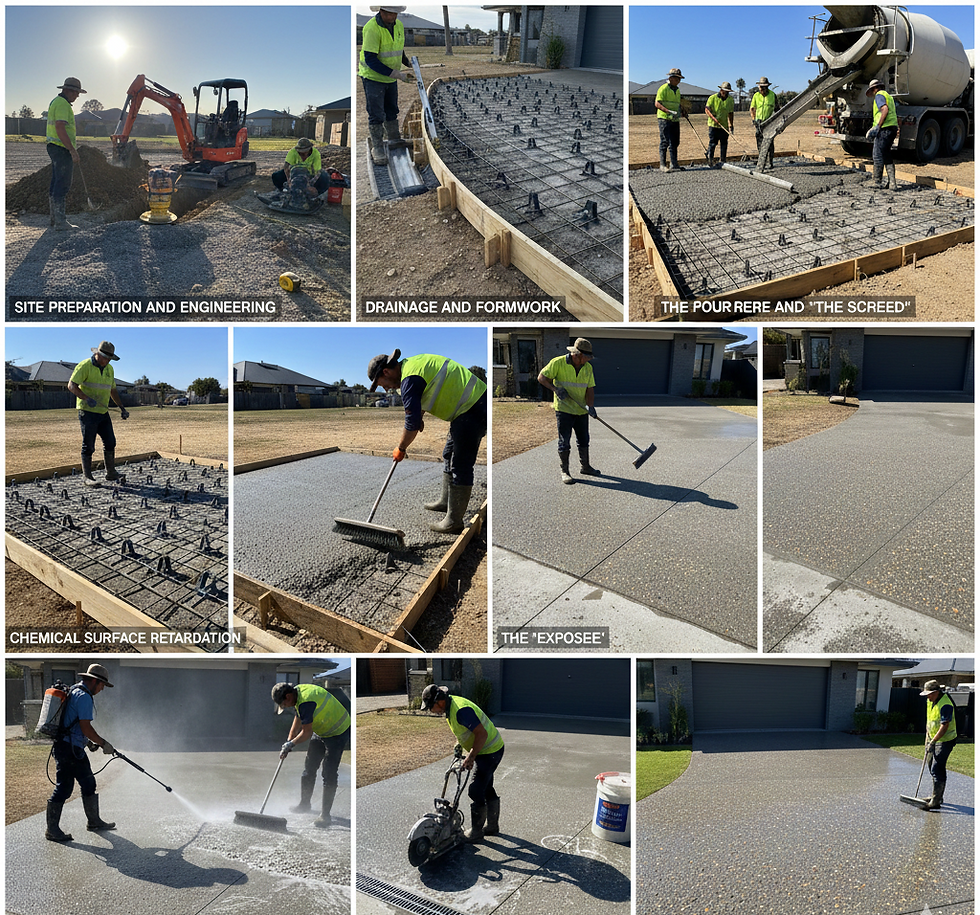
Installing a modern exposed aggregate driveway is a high-stakes, time-sensitive operation. A professional Australian crew usually consists of 3 to 6 people, each with a specific role, often starting at sunrise to beat the midday heat.
Step 1: Site Preparation and Engineering
The process begins with excavation. A professional service won't just pour over your old driveway. They will dig to a depth of approximately 100mm to 150mm. They then lay a sub-base of crushed road-base, which is compacted using a heavy vibrating plate. This is the most important step; without a compacted base, the driveway will crack as the clay-heavy soils found in many Australian regions shift.
Step 2: Drainage and Formwork
A professional will assess the "fall" of your land. Driveways must have a minimum slope (usually 1:100) to ensure water runs off into drains rather than pooling near your house foundations or flowing into your neighbour's property. Timber or flexible plastic forms are installed to define the shape. If you have curves, the contractor will use specialised flexible forms to ensure smooth, professional lines.
Step 3: Steel Reinforcement
Steel reinforcement mesh (usually SL72 or SL82 grade as per Australian Standards) is laid throughout. Crucially, a professional will use "chairs" to lift the mesh into the centre of the slab. Many DIY-ers or low-quality contractors leave the mesh on the ground, where it does absolutely nothing to strengthen the concrete.
Step 4: The Pour and "The Screed"
The concrete arrives in a mixer truck. Because aggregate mixes are "stiff," they are hard to move. The crew will use rakes and shovels to spread it, followed by a "screed" to level it. They then use a "bull float" a large flat tool on a long pole to smooth the surface and push the decorative stones just below the surface cream.
Step 5: Chemical Surface Retardation
This is the "magic" step. Instead of just letting the concrete dry, the contractor sprays a chemical surface retarder over the wet slab. This chemical prevents the top 2-3mm of cement from hardening. The timing of this application is dictated by the temperature, humidity, and wind speed—factors that change rapidly in the Australian climate.
Step 6: The "Exposure" (The Reveal)
Hours later or sometimes the next morning the crew returns for the wash-off. Using a high-pressure water jet and industrial brooms, they strip away the soft surface paste. This is a delicate process; too much pressure and the stones fall out; too little and the stones stay hidden.
Step 7: Expansion Joints and Acid Wash
Concrete expands and contracts. To prevent ugly, jagged cracks, the professional will use a diamond-blade saw to cut "control joints" into the slab at specific intervals (usually every 3-4 metres). They will also perform a light acid wash to remove any "haze" from the stones, ensuring they look bright and vibrant.
Step 8: The Final Seal
Once the slab has cured (usually 3 to 7 days later), a high-quality acrylic sealer is applied. This is what gives the driveway that "magazine-ready" look and protects the stones from the intense UV radiation found across Australia.
6. Hiring a Professional: The Homeowner’s Checklist
Since you are looking to get a decorative exposed aggregate driveway done by a professional service, you must know how to vet them. Not all concrete contractors are experienced in the nuances of aggregate finishing.
Questions to Ask Your Contractor
"Can I see a local project you finished 2+ years ago?" New concrete always looks good. You want to see how their work handles two years of Australian weather and heavy vehicle use.
"What grade of steel mesh do you use, and do you use chairs?" If they say they don't use chairs, find another contractor. This is a non-negotiable for a quality slab.
"Do you provide a written warranty against structural cracking?" Note: Hairline cracks are normal in concrete, but major structural cracks should be covered by a reputable company.
"Is the sealer included in the quote, and what type is it?" You want a high-solids acrylic sealer that can withstand Australian UV levels.
"How do you handle drainage and council permits?" They should be able to explain exactly where the water will go and if you need a "Crossover Permit" from your local Council.
Red Flags to Watch For
Extremely Low Quotes: Aggregate is expensive. If a quote is 30% lower than others, they are likely cutting corners on the thickness of the concrete, the quality of the steel, or the strength of the cement mix.
No Expansion Joints: If they say "the concrete won't crack," they are being dishonest. All concrete cracks; the joints just control where it happens.
Pouring in the Rain: Rain can ruin an aggregate finish by washing away the retarder or the cement paste prematurely. A professional will always reschedule if the weather is poor. Experts like Coastal Concreting & Landscaping will often watch the radar for hours to ensure the conditions are perfect before starting the pour.
7. Cost Analysis and Budgeting
A premium aggregate driveway is a high-end product. It generally costs more than standard grey concrete (which might be $60-$80 per square metre) or coloured concrete ($80-$100). For a professional installation, you should budget between $100 and $150 per square metre, depending on your location and the complexity of the project.
Why the Cost Variation?
Stone Choice: Basic river pebbles are affordable. Rare blue granite or imported Italian quartz can double the material cost per cubic metre.
Site Access: If a concrete truck can't drive right to the pour site, you’ll need a concrete pump, which typically adds $500–$800 to the daily cost in most Australian cities.
Excavation Labour: If you have an old, thick reinforced concrete driveway that needs to be jackhammered and removed, this can add thousands to the labour bill and disposal fees.
Permits: Depending on your local Council, you may need a permit to cross the "nature strip" or "verge." A professional contractor will often handle this for you but will bill for the time and administrative fees.
8. Maintenance, Longevity, and Seasonal Care
An Exposed Aggregate Driveway is a 30 to 50-year investment if you follow a basic maintenance schedule suited to our environment.
The 3-Year Sealing Rule
The sealer is the most important maintenance item. It protects the cement matrix from "spalling" (chipping) and prevents oil from soaking into the porous surface. You should re-seal your driveway every 2 to 3 years.
Test: Pour a cup of water on the driveway. If it beads up, the sealer is fine. If it soaks in and makes the concrete look dark and wet, it’s time for a fresh coat to maintain that pebblecrete driveway finish.
Dealing with Oil and Stains
If your ute or car leaks oil, don't wait. Concrete is naturally porous.
The Fix: Use a specialised alkaline concrete degreaser available from hardware stores. Apply it to the stain, let it sit for 20 minutes, scrub with a stiff brush, and rinse. For organic stains like eucalyptus leaves or bird droppings, a simple mixture of bleach and water usually works wonders.

Seasonal Care: The Australian Context
Summer: In extremely hot weather, you can hose down the driveway to cool it. High heat can cause concrete to expand rapidly; ensuring your expansion joints are clear of pebbles and dirt will allow the slab to move as intended without buckling.
Storm Season: Ensure your drains and "grate drains" at the bottom of the driveway are clear of debris. The texture of an exposed concrete driveway can catch small leaves, which might eventually wash into and block your drainage systems.
9. Troubleshooting Common Issues
Even with a professional install, concrete is a natural product and issues can arise. Here is what to look for on an aggregate concrete driveway:
Hairline Cracks (Crazing)
These are tiny, spider-web cracks on the surface. They are usually purely aesthetic and don't affect the strength of the driveway. They are often caused by the surface drying too quickly on a windy day. A high-quality sealer often hides these completely.
Stones "Popping" Out
If you lose 5-10 stones in the first month, don't panic. These were likely just loose on the surface. If you are losing hundreds of stones, the contractor may have "over-exposed" the mix. This requires a professional assessment and potentially a heavy-build resin coating to lock the remaining stones in.
Discoloration or "Clouding"
If your driveway looks white or "cloudy" after sealing, it usually means moisture was trapped under the sealer. This can happen if it was sealed too soon after rain. This can be fixed by a professional using a "Xylene" wash, which re-activates the sealer and allows the moisture to escape.
10. Final Considerations: Is It Right for Your Home?
Investing in an Exposed Aggregate Driveway from a professional service is one of the most effective ways to increase your home's kerb appeal and market value. It is a choice that prioritises long-term durability and safety without sacrificing the "wow factor" that makes a property stand out in the street.
By selecting a custom stone mix that complements your architecture, ensuring your contractor uses proper steel reinforcement and drainage techniques, and committing to a simple re-sealing schedule, you ensure that your driveway remains a beautiful, functional asset for decades.
Final Thought for the Homeowner: Your driveway is the first chapter of your home's story. While a concrete exposed driveway may cost more upfront than a simple asphalt or plain concrete slab, the lack of maintenance and the sheer beauty of the stone finish make it the most cost-effective premium paving solution on the Australian market today. When you see the way the sunlight catches the quartz in your driveway as you pull into your garage, you’ll know it was worth every cent.

If you're ready to transform your property, please feel free to Contact Us for a personalized quote and expert advice.


I appreciate the practical information about garage door repairs and pricing. Many homeowners may not realise how several different components work together to operate a garage door safely. When something starts making strange sounds or becomes difficult to open, getting it checked early is sensible. Repair costs can vary depending on the problem, but timely maintenance may help reduce the chance of expensive component damage and unexpected breakdowns.